
DISTRIBUTED ELEMENT MODEL IN TRANSMISSION LINES (PART II)
In our previous post in this section, we stated what we will study next to characterize the Distributed Model:
- The transmission lines equations
- Solve and exercise applying the equations
- Propagation constant and characteristic impedance of the line
- Solve and exercise calculating this parameters on a real line
In this post, we will see points 1 and 2.
Distributed Element Model
Recall the representation and meaning of the distributed elements in a transmission line:

These parameters vary according to the type of line. For example:

Note: click on the images to see a better resolution. Then, click to go back in your browser to come back to the post 😉
The transmission lines equations
When using the distributed element model, we can apply the Kirchhoff laws:
And the solutions are: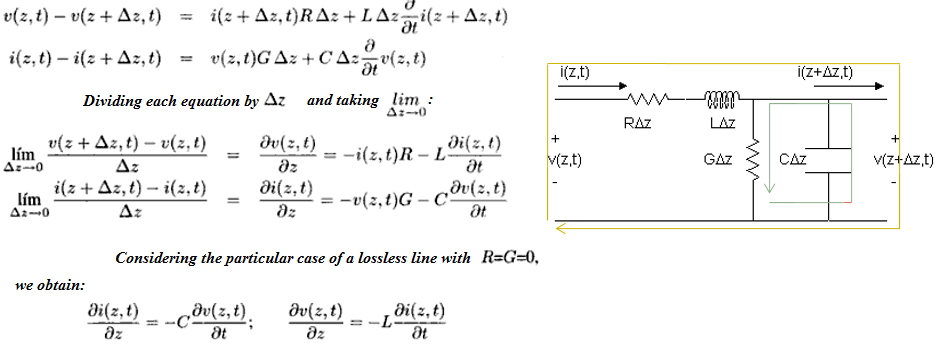
Exercise Explained:
The distributed coefficients of a transmission line with w =104 rad/sec are:
R = 0.053 Ω /m L = 0.62 mH/m G = 950 pS/m C = 39.5 pF/m.
In the z-coordinate over the line, the instantaneous current is given by:
i(t) = 75 cos 10 4t mA
a) Obtain the expression for the voltage gradient along the line, in the point z.
b) What is the maximum value of the voltage gradient?
Solution:
a)
In the time domain, the voltage gradient is given by:

Substituting values, we have:
= - 0.053 ( 0.075 cos 10 4 t) + ( 0.62 x 10 -6 ) (0.075 x10 4 sin 10 4 t) =
= - 3.98 x10 -3 cos 10 4 t + 0.465 x 10 -3 sin 104 t =
…
= 4.006 x10 -3 cos( 10 4 t - 3.03) Volts/meter.
= 4.006 x10 -3 cos( 10 4 t - 173.4 ° ) Volts/meter.
b)
The maximum voltage gradient is equal to the amplitude, 4 mV. This happens when:
cos(104 t - 3.03) = 1
This implies that,
104 t - 3.03 = 0 , 2π , 4π … Radians.
This occurs in the following instants of time:
t0 = 3.03 / 104 = 3.03 x 10⁻⁴ sec ,
Then
t0 = 303 ms
t1 = (2π + 3.03) / 104 = 9.31 x 10⁻⁴ sec , t1 = 931 ms, …
tn = (nπ + 3.03) / 104 sec, with n = 0, 2, 4 …
What’s next?
We hope this post was useful 🙂 In the next post in this section, we will cover the points:
3. Propagation constant and characteristic impedance of the line
4. Solve and exercise calculating this parameters on a real line
After that, we will move to the the parameters when the line is in a transient state which analyses what happen when there is a sudden change in the conditions of the line.
Does this sound interesting? 😀
Related Posts


About The Author

behindthesciences
We are two engineers who work in the Electronic and Telecommunication industry. We regularly blog in our spare time.